Every corner of the city, connected.
Every neighborhood.
Every game. Every flight.
Our vision: a Loop tunnel network connecting all of Chicago's neighborhoods to the places Chicagoans love to go. Wrigley, Sox Park, Soldier Field, the United Center, McCormick Place, the Museum Campus, Navy Pier, O'Hare, and Midway. Skip the traffic, skip the parking, and get from your block to the action.
Neighborhoods all over Chicago
It starts here. Our vision is a citywide Loop network that reaches neighborhoods all over Chicago, north, south, and west, not just downtown. Wherever you live, the whole city should feel close.
Neighborhoods shown are the campaign's vision of where a city network could reach. No routes have been approved or planned by The Boring Company. See proposed access points.
From your block to the big game
The point is simple: every neighborhood connected to the stadiums, museums, airports, and venues that make Chicago great.
Wrigley Field
Home of the Cubs, in Lakeview.
Sox Park
Rate Field, home of the White Sox, in Bridgeport.
Soldier Field
Home of the Bears, on the lakefront.
United Center
Home of the Bulls and Blackhawks, on the Near West Side.
Chicago Fire
The Fire's new stadium under construction at The 78 in the South Loop.
McCormick Place
North America's largest convention center, near the South Loop.
Museum Campus
The Field Museum, Shedd Aquarium, and Adler Planetarium.
Art Institute of Chicago
World-class art, steps from Millennium Park.
Museum of Science and Industry
A Hyde Park favorite for all ages.
Navy Pier
Lakefront fun, food, and fireworks in Streeterville.
O'Hare Airport
Your flight, without the Kennedy.
Midway Airport
The Southwest Side's airport, closer than ever.
Example trips are the campaign's vision, not planned routes. No routes have been approved or planned by The Boring Company.
Where stations could be
The campaign's illustrative vision of potential Loop station locations across Chicago: neighborhoods all over the city plus the stadiums, museums, and airports people want to reach. Tap a marker for details.
Illustrative visionEvery location is the campaign's illustrative vision for discussion. No stations or routes have been studied, approved, or planned by The Boring Company or any public agency. Map data © OpenStreetMap contributors. See all proposed access points.
Same time any time of day. No traffic.
Rush hour or midnight, game day or snow day, a tunnel trip would not care what is happening on the Kennedy or Lake Shore Drive. Here is how far apart some of Chicago's busiest trips really are.
| Trip | Distance | Time at 60 mph |
|---|---|---|
| Soldier Field to Wrigley Field | 6.3 mi | ~6 min |
| O'Hare Airport to The Loop (Daley Plaza) | 15.6 mi | ~16 min |
| Midway Airport to McCormick Place | 8.3 mi | ~8 min |
| Hyde Park (57th and Ellis) to Wrigley Field | 11.2 mi | ~11 min |
| Rogers Park (Loyola station) to Museum of Science and Industry | 15.1 mi | ~15 min |
| Logan Square (Milwaukee and Logan) to United Center | 3.8 mi | ~4 min |
| Pilsen (18th Street) to Navy Pier | 3.5 mi | ~4 min |
| Austin (Central and Chicago) to Soldier Field | 8.0 mi | ~8 min |
| Bronzeville (35th and King) to O'Hare Airport | 18.0 mi | ~18 min |
Straight-line distance at a steady 60 mph, illustrative; actual tunnel routes, stops and speeds would vary. These are not Boring Company speeds or plans for Chicago.
It already works
The Boring Company's all-in cost target for a Loop tunnel with Prufrock.
Why tunnels, why Chicago, why now
Illinois already builds underground
Chicago dug roughly 60 miles of narrow-gauge freight tunnels under the Loop in the early 1900s, and the Metropolitan Water Reclamation District's Tunnel and Reservoir Plan (the "Deep Tunnel") runs through the region's limestone and dolomite bedrock. Tunneling is part of our history.
Surface space is maxed out
Widening expressways through dense neighborhoods and farmland is slow, disruptive, and expensive. Tunnels move traffic below the surface while leaving homes, fields, and wetlands in place.
The technology has moved
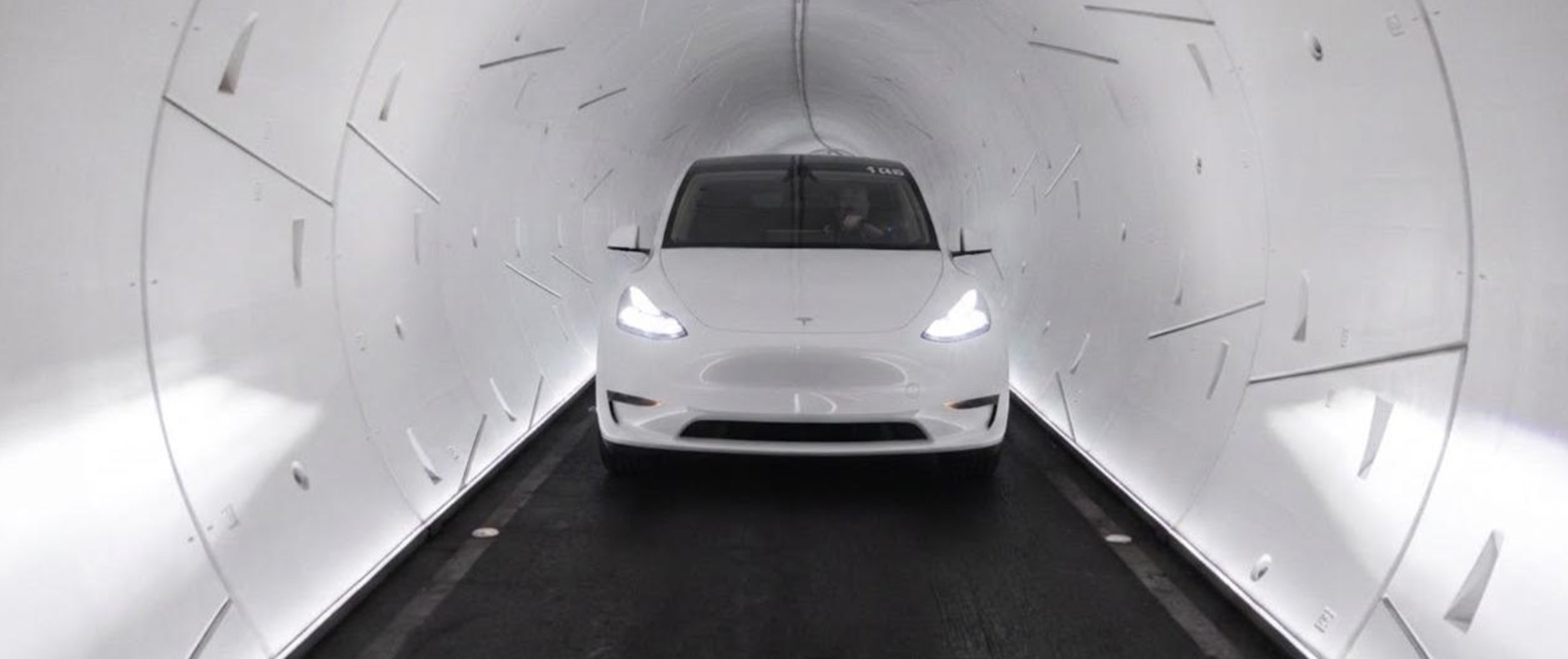
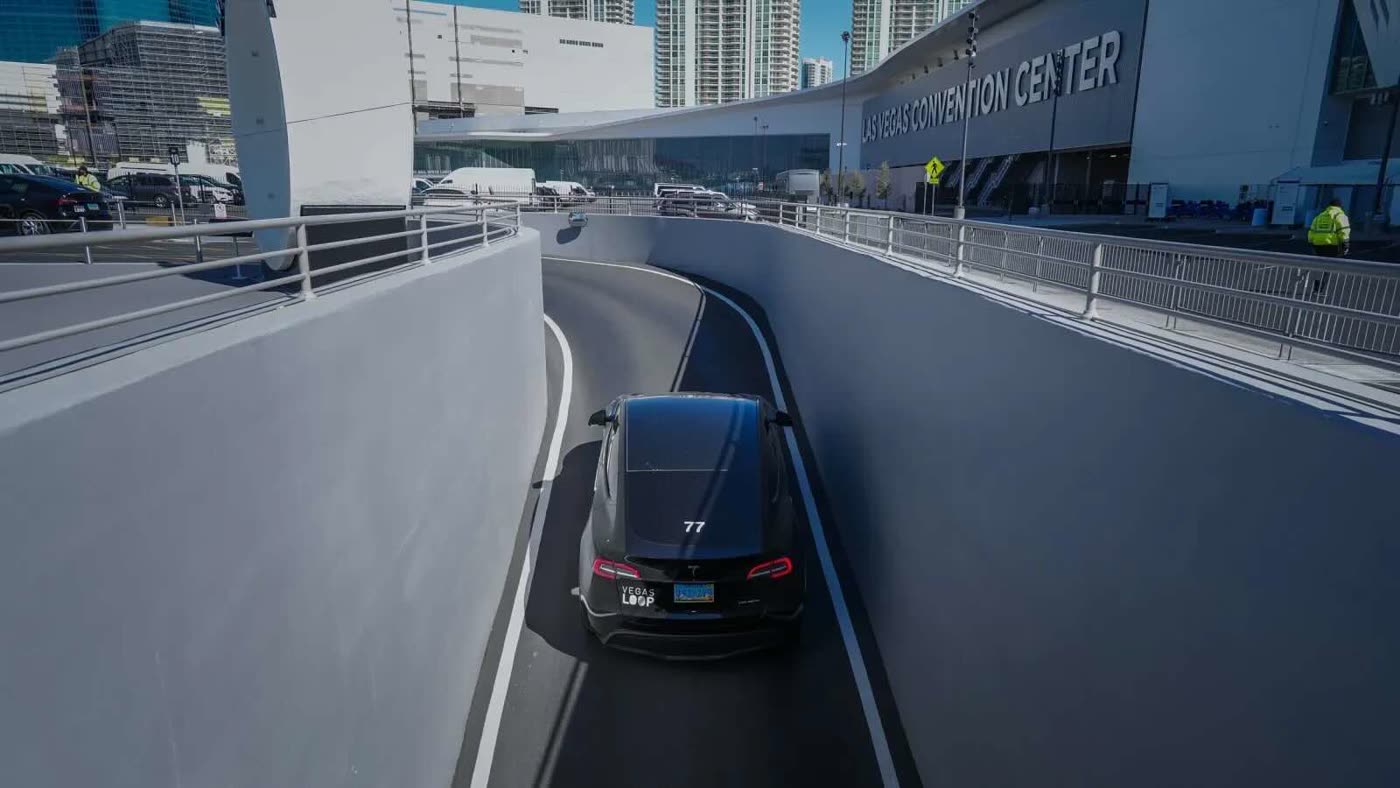
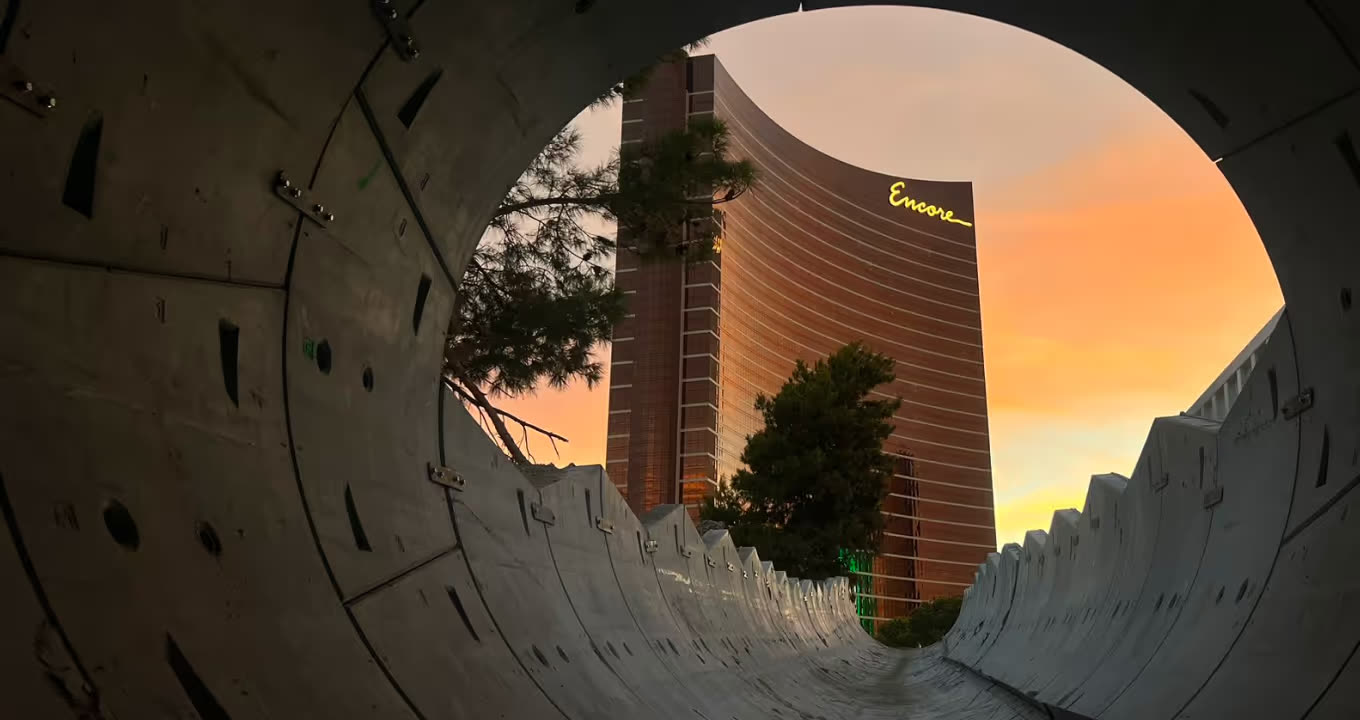
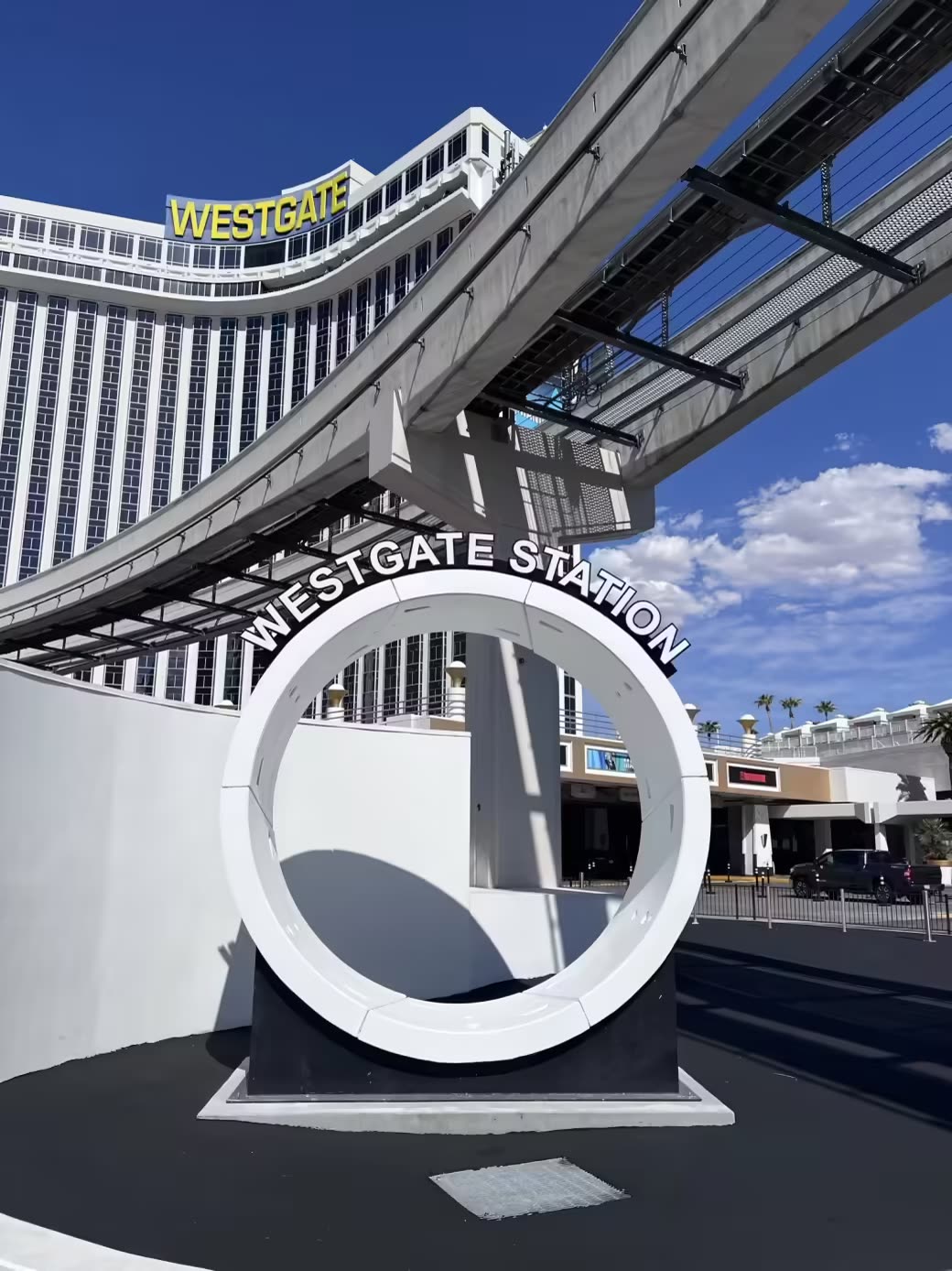
Tunneling companies like The Boring Company are working to make smaller-diameter tunnels faster and cheaper to build. Their Las Vegas Convention Center Loop has been carrying passengers since 2021.
Small cars, point to point
Most car trips carry just one or two people: the average household vehicle trip in the U.S. carries about 1.5 people. So the most efficient way to move people is in small vehicles for one or two riders, moving quickly, not big buses or trains. With a train, you get to a station, ride, then take a car or bus from another station to where you are actually going. Loop tunnels are point to point, door to door.
Room for a CTA's worth of trips
Chicago's transit system is remarkable. On an average weekday in 2025, riders took about 1.04 million rides on the CTA. A Loop network would not replace that. It would add capacity alongside it.
The Boring Company's stated target capacity for the full Vegas Loop, with 104 medium-sized stations.
The simple math: 1,042,505 rides ÷ 90,000 per hour = about 11.6 hours. At that capacity, a Loop system could carry as many trips as the CTA does in a weekday in under 12 hours of operation.
This is a capacity comparison, not a ridership prediction. The 90,000 per hour figure is a target for a full Vegas network, not a Chicago plan, and CTA counts rides (boardings), not unique people. The goal is to complement the CTA, giving Chicagoans one more great way to get around.
No cost to the city. Time back for Chicago.
Zero cost to the city
Our model and goal: a system that is privately funded and privately operated, with no city operating subsidy. The city would not pay to build it and would not carry annual costs to run it. The one likely public cost is a police presence at major stations, if the city chooses to provide it.
There is precedent. Clark County approved a 50-year franchise for the Vegas Loop, which is funded privately with no taxpayer money: The Boring Company pays for the tunnels, and properties pay for their own stations. The Boring Company also pays the county a franchise fee based on revenue.
This is the campaign's proposal. No agreement with the City of Chicago exists.
Time back, and a city that prospers
When people get their time back and the city moves more efficiently, Chicago prospers. Right now congestion is a heavy drag:
- No. 1 in the U.S.: Chicago drivers lost 112 hours to congestion in 2025, costing the typical driver $2,063 and the city $7.5 billion in lost time (INRIX 2025).
- $11.8 billion a year: the annual cost of congestion in the Chicago IL-IN area in 2024, or $2,363 per auto commuter, with 87 hours of delay per commuter (TTI 2025 Urban Mobility Report).
Every hour returned is an hour for work, family, and the neighborhood businesses that make Chicago great.
Easier commutes bring people back downtown
When getting to the office is fast and easy, more people choose to come in. Shorter, faster commutes bring workers back into the city, and with them the lunch crowds, after-work traffic, and street life that revitalize downtown. The research points the same way:
- Commuting is the top reason to stay home. Not commuting remains the No. 1 benefit of working from home in the Survey of Working Arrangements and Attitudes (March 2025), and workers with longer commutes want more remote days (Barrero, Bloom, and Davis, NBER, revised October 2026).
- Short commutes lead the office recovery. Placer.ai found that office visits from within five miles recovered fastest and grew fastest in the first half of 2026. In Chicago, 41.5% of office visits came from within five miles.
- Chicago is ready to come back. Kastle badge data showed Chicago office occupancy at 66.0% on Tuesday, June 30, 2026, fifth among the 10 metros it tracks, while downtown vacancy stood at 26.6% (Newmark, Q2 2026).
Make the trip downtown quick and predictable, and more of Chicago shows up.
Door to door, no transfers
Our proposal works less like the L and more like Uber with a superpower. You get picked up at your door, whether that is home, work, a restaurant, or an appointment, and dropped off wherever you are going. The car uses normal roads when they are clear and drops into the tunnels to skip congestion or reach final mile points.
Picked up at your door
Home, office, restaurant, appointment. Wherever you are.
Drops into the tunnel to skip traffic
A nearby portal takes the car underground, past the gridlock, nonstop.
Surfaces near your destination
It pops back up close by and drops you at the door. No connections, no transfers.
You ride in an electric car: Tesla vehicles today, with a high-occupancy van planned for big events and, under our proposal, any approved autonomous electric vehicle in the long run. Inside the tunnel, cars drive on a road surface about 9.5 feet wide. More on the technology.
Pay per ride, or ride all you want
Our proposal: 100% privately funded, zero tax dollars. Riders pay instead, the way that suits them. A single ride would be comparable to a CTA fare, and passes are for frequent riders.
Single ride
One-time ride fee, comparable to a CTA fare.
Daily pass
Unlimited rides for a day out or a busy workday.
Weekly pass
For a week of commuting or visiting.
Monthly pass
For regular commuters.
Annual pass
For everyday riders who want it all year.
Prices have not been set. This is the campaign's proposal, not a guarantee. For reference, a full CTA 'L' fare is $2.50 (transitchicago.com).
The car already knows you
Our vision for the in-car experience: your saved settings load the moment you get in.
Your temperature
The car knows who it is picking up and has the cabin set the way you like it.
Your music and shows
Your Spotify and Netflix logins, ready when you sit down.
Fast Wi-Fi
Satellite or high-speed internet to knock out calls and email on the way.
Camera for calls
Take a Zoom or Google Meet call from a quiet, private cabin.
Know your destination
Info on where you are headed, plus the best things to do in the city today.
Or just nap
Recline and rest, feeling safe because the ride is yours alone.
These are the campaign's vision of features, not current Boring Company products.
9 reasons it's safer
Your own private car
Picked up at your door, dropped where you choose, riding with only the people you pick.
No head-on collisions
Each tunnel runs one direction. No third rail, and a lit roadway you can walk out on.
Watched over 24/7
100% camera coverage, a staffed control center, cameras in and around the car, and Tesla's Robotaxi record: 0 injuries in 3.1 million driverless miles (Jan 22 to Oct 18, 2026).
Chicago has the worst traffic in the nation.
Time is the one thing none of us can earn back. Every hour stuck on the Kennedy or the Dan Ryan is an hour taken from family, work, rest, and the people we love. Tunnels give Chicagoland something more valuable than speed: they give people back their time.
Most congested urban area in the U.S. in 2025, and 3rd worldwide by INRIX impact rank.
Lost to congestion per Chicago driver in 2025, up 10% from the prior year.
Cost of that lost time for each Chicago driver in 2025.
Average one-way commute in the Chicago metro, versus 27.2 minutes nationally (2024).
Safer and faster than ever
Zero People In Tunnel
The boring machine is designed to be operated remotely, with no one in the tunnel during normal operations. That dramatically reduces the safety risk of tunneling.
It never stops
Concrete wall segments go in like Lego blocks while the machine keeps boring. Muck rides out on a conveyor, segments ride in underneath, and a robotic arm installs them.
One standard design
Every tunnel is essentially the same, about 14 feet in diameter, so the mechanical, electrical, and plumbing engineering does not have to be redone each time. That speeds permitting and cuts cost.
Deep and precise
Tunnels run below city utilities, typically around 30 feet down and deeper where needed, with guidance The Boring Company says is accurate to within 2 inches.
1 mile per week
The Boring Company's stated target for its Prufrock machine. In Nashville, multiple machines are already tunneling at once.
O'Hare to the Loop in about 4 to 5 weeks of boring
Illustrative math: 17 miles of twin tunnels is 34 tunnel miles. With 8 machines at The Boring Company's 1 mile per week target, that is about 4 to 5 weeks of tunneling, before permitting, stations, and fit-out. See the math.
Cheaper, faster, quieter
A fraction of the cost
U.S. tunneled transit can run into the billions per mile. The Boring Company targets less than $5M per mile for a Loop tunnel.
Zero wait, no stops
Vegas Loop's median wait is zero seconds, and every trip is nonstop.
Neighbors won't notice
No traffic lane closures for tunneling, and no detectable noise or vibration at depth.
Let's be the city that says yes.
The Boring Company says it builds "in welcoming communities," and that community support and political support help decide whether a project moves forward. In Nashville, it says, "all the boxes were checked." We want Chicago and Illinois to check every box.
Built in America
The Boring Company designs and builds its own tunnel boring machines at its factory in Bastrop, Texas, making about 99% of Prufrock's structures and assemblies in house.
A model built for this
It is building privately funded, point to point Loop networks with its own machines, in Las Vegas and now Nashville.
Chicago has been here before
In 2018 Elon Musk said Chicago's small number of approving authorities was "one of the assets" of the city. Let's show that support again.
Windy City Loop is independent and not affiliated with The Boring Company. We are asking Illinois leaders to welcome it and other qualified firms.
Our proposed partner: The Boring Company
We are advocating that Illinois invite The Boring Company to bid on and help build this network. Here is what is publicly known about their work:
LVCC Loop
An underground system beneath the Las Vegas Convention Center campus, opened in 2021, carrying visitors in Tesla vehicles between convention halls through twin tunnels.
Vegas Loop
A larger network approved by Clark County to expand the system across the resort area and downtown Las Vegas, with new stations opening over time, including service to resorts.
Prufrock
The Boring Company's tunnel boring machine line, designed to launch from the surface ("porpoising") rather than requiring a deep launch pit, with the goal of much faster tunneling than conventional machines.
Windy City Loop has no relationship with The Boring Company and does not speak for it. Chicago previously selected The Boring Company in 2018 for a proposed O'Hare Express; that project did not move forward. We think the case deserves a fresh, transparent look. See their own site, boringcompany.com, for current details.
Freight could move underground too
Goods, not just people
In the future, tunnels could carry freight as well as riders: semi-trucks, shipping containers, and big boxes moving below the city instead of on crowded streets and expressways. Freight trains could run in purpose-built tunnels too. This is the campaign's vision of future potential, not a current Boring Company offering.
The Boring Company recently showed a shipping container making it through a tunnel (October 19, 2026).
@boringcompany on X · Oct 19, 2026"Using TBC tunnels to transport freight. The latest Prufrock Liner Truck (using Tesla Model 3 batteries and drive units) has been modified to carry a standard 20’ shipping container. Fits like a glove!"View the post and video →The vision at a glance
Neighborhoods
North Side, South Side, West Side, and downtown, all connected.
Stadiums
Wrigley, Sox Park, Soldier Field, the United Center, and the Fire's new home.
Museums and venues
Museum Campus, the Art Institute, MSI, Navy Pier, and McCormick Place.
Airports
O'Hare and Midway, from your door.
Long term: expanding across the state.